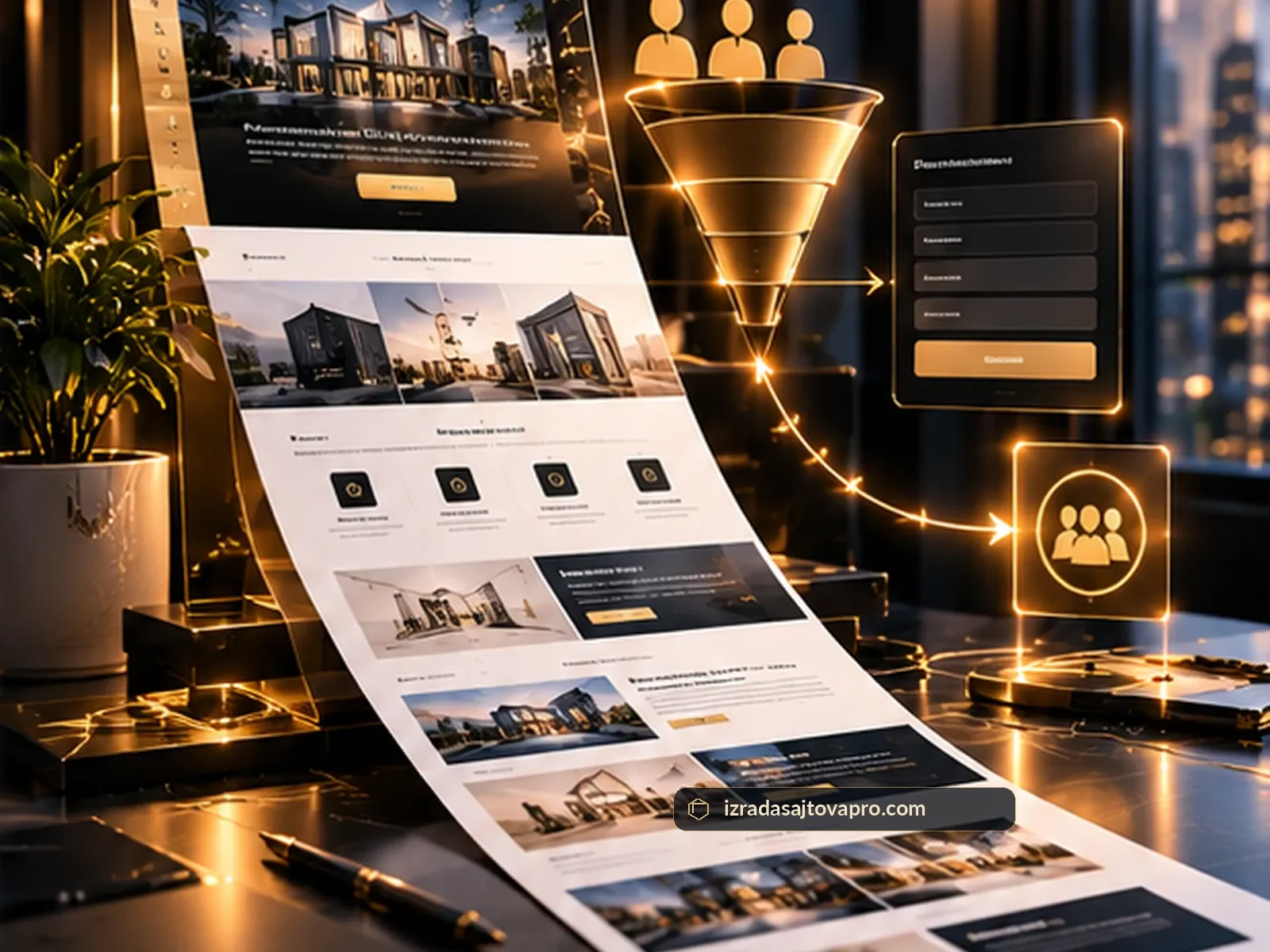
Goal and scope
For Landing page design, we first clarify the business goal, the current situation and what the user should be able to understand or do. The scope follows that logic instead of a fixed template.
See how Landing page design can support a concrete business goal, what the service includes, how the work is organized and which decisions matter before implementation.
For Landing page design, we focus on the business goal, the scope that really matters, a clear content structure and reliable implementation. The points below show what is included and how the work is organized.
For Landing page design, we first clarify the business goal, the current situation and what the user should be able to understand or do. The scope follows that logic instead of a fixed template.
We organise the content for Landing page design so that the main offer is easy to scan, important questions are answered at the right moment and the next step is visible without unnecessary friction.
Implementation for Landing page design is checked on real screen sizes and against the functions that matter for the page. Where relevant, we also verify tracking, forms, search signals and technical dependencies before launch.
Our approach to Landing page design starts with the goal and available inputs, then moves through structure and content to implementation and verification. This keeps decisions connected to a practical outcome rather than isolated design or technical choices.
We define the goal, audience, existing assets and constraints that matter for Landing page design.
For “Landing page design”, we turn those inputs into a clear structure, useful content and a user journey that supports the intended action.
For “Landing page design”, we implement the agreed scope, test the important paths and check the technical details before the page, campaign or configuration is considered ready.
Yes. For “Landing page design”, we first review the current situation and keep what already works. The scope is adjusted to the real goal, existing assets and technical constraints.
For “Landing page design”, we need a short description of the goal, access to relevant accounts or the existing website when needed, and the business information that should be reflected in the final result.
For “Landing page design”, we agree the deliverables in advance and verify the relevant user journey, technical checks and measurement points before handover or launch.
A high-converting landing page is never created by accident. It is the result of rigorous structural planning, behavioural psychology, and meticulous visual communication. Unlike standard corporate websites that serve multiple navigation objectives, a specialized landing page has one single baseline directive: guiding a specific audience toward a single, measurable conversion event. Whether that goal is generating high-intent B2B inquiries, capturing direct consumer leads, securing software trial sign-ups, or initiating instant purchases, the visual and narrative flow must align directly with how humans process information under digital decision-making pressure.
Our strategic approach to landing page architecture relies on proven psychological frameworks such as the AIDA (Attention, Interest, Desire, Action) structure and the F-Shaped reading pattern. When a user lands on your page from a targeted ad campaign, search query, or social promo, you have fewer than 3 seconds to confirm relevance, communicate your unique value proposition (UVP), and earn their continued attention. We structure the layout so that cognitive friction is entirely eliminated, leading the user's eye naturally down a clear visual track toward your call-to-action (CTA).
Key structural components we engineer for maximum impact include:
The area visible on screen before a user initiates their first scroll—known as the 'above-the-fold' area—accounts for over 57% of total viewing time and up to 80% of immediate bounce rates if executed poorly. On modern mobile and desktop displays, optimizing this real estate requires a precise balance of visual hierarchy, copy density, loading speed, and functional clarity.
When we design the hero section of your landing page, we ensure that four core questions are answered instantly without requiring the user to guess: What is this product or service? What primary problem does it solve? Who is it specifically designed for? And what exact step should the visitor take right now? Eliminating ambiguity at this top level yields dramatic increases in scroll depth and lead capture performance.
Furthermore, we deploy media assets—such as custom product screenshots, interactive illustrations, or short explanatory hero videos—with ultra-lightweight performance budgets. By delivering visually striking visuals without sacrificing rendering speed, your brand creates an immediate impression of authority, technical excellence, and modern reliability.
Design creates structure and visual attraction, but copy is what closes the deal. The copy on a landing page must strike a delicate balance between conciseness, technical clarity, and emotional resonance. Passive, generic corporate language ("We provide leading digital solutions for businesses") fails to engage modern digital consumers. Instead, high-converting landing page copywriting utilizes active voice, benefit-focused subheadings, actionable bullet points, and razor-sharp value propositions.
Equally critical is micro-copy—the subtle instructional text placed inside input fields, right under CTA buttons, or next to price tags. Micro-copy addresses immediate micro-anxieties. Phrase additions like "No credit card required," "100% free consultation with zero obligation," or "Guaranteed reply within 2 hours" significantly increase form completion rates by reassuring users at the exact moment of decision.
Hick’s Law dictates that the time it takes for a user to make a decision increases logarithmically with the number and complexity of choices presented. Standard websites frequently confuse visitors by presenting dozens of navigation menus, sidebar links, internal blog recommendations, and multiple competing goals. When paid ad traffic lands on such pages, conversion rates plummet because users experience choice paralysis and exit without taking action.
Our landing page designs eliminate standard top-level navigation menus and external footer outbound links unless explicitly required for compliance or secondary navigation. By stripping away extraneous distractions, we preserve single-minded conversion tunnels. Every design element—from whitespace management, typography sizing, contrast ratios, to directional cues—is intentionally crafted to draw the eye toward your core offer.
In an online ecosystem where consumer skepticism is at an all-time high, trust is the primary currency of online sales. A landing page lacking strong, verifiable trust signals will struggle to convert even high-intent traffic. We incorporate multi-layered social proof frameworks tailored to your industry to build instant credibility:
By positioning these social proof modules adjacent to friction points—such as price tables or form submissions—we neutralize doubt before it turns into page abandonment.
The conversion form is the ultimate gateway between a casual visitor and a revenue-generating lead. Poorly designed forms with excessive input fields, ambiguous validation errors, or non-responsive mobile layouts can instantly sink an otherwise brilliant ad campaign.
We engineer lead capture forms utilizing advanced UX patterns. For complex B2B offerings or high-value service quotes, we implement multi-step dynamic forms (wizards) that break inquiries into bite-sized, non-threatening micro-questions. Studies demonstrate that multi-step forms can increase submission rates by over 300% compared to long, daunting single-page form fields. We also utilize auto-fill capabilities, real-time input validation, inline helpful error messages, and touch-optimized input selectors for seamless mobile completion.
Sending paid search traffic from Google Ads to a generic homepage is one of the quickest ways to waste ad budget. Google Ads relies heavily on Quality Score—a metric calculated based on expected click-through rate, ad relevance, and landing page experience. When your landing page copy, headings, and keyword structures perfectly mirror the search terms and ad copy in your Google Ads campaign, your Quality Score increases significantly.
Higher Quality Scores lead to two massive competitive advantages: lower Cost-Per-Click (CPC) and higher ad positioning in search auction results. We build bespoke Google Ads landing pages designed to achieve maximum landing page relevance ratings, ensuring every dollar of your media spend produces the highest possible return on investment (ROI).
Traffic originating from social platforms like Facebook, Instagram, LinkedIn, or TikTok behaves fundamentally differently from search traffic. Search users actively look for immediate solutions, whereas social media users are consuming content in a passive or discovery state. Therefore, landing pages tailored for social ad traffic require a distinct visual and storytelling approach.
We maintain perfect visual 'Message Match' between your ad creatives (videos, visual carousels, image ads) and the destination landing page. The brand imagery, colors, headline hook, and emotional tone of the ad must be echoed immediately upon landing. This seamless transition prevents bounce spikes caused by visual dissonance and reassures social users that they have landed in exactly the right place.
The true metric of success for any paid digital marketing campaign is not impressions or clicks, but Cost-Per-Acquisition (CPA) and customer lifetime value. By pairing targeted ad campaigns with high-converting custom landing pages, businesses typically see dramatic performance lifts compared to driving traffic to standard website pages.
If your current campaign converts at 2% on a generic page with a $50 CPA, boosting the conversion rate to 6% via a dedicated, professionally optimized landing page instantly slashes your CPA down to $16.66—tripling your lead volume without spending an extra cent on ad networks. Our landing page design service focuses ruthlessly on this mathematical leverage point.
Page speed is not merely a technical detail—it is a critical conversion factor. Research shows that every additional second of delay in page load time reduces conversion rates by up to 20%. Mobile visitors on standard cellular networks will abandon a landing page entirely if visual rendering takes longer than 2.5 seconds.
Our development standards prioritize extreme performance optimization. We write clean, lightweight HTML5, CSS3, and modern JavaScript code without heavy unnecessary frameworks or bloated third-party page builders. Assets are optimized using next-gen image formats (WebP/AVIF), asset minification, critical CSS inline rendering, and server-level caching. As a result, our landing pages routinely achieve top-tier Google PageSpeed Insights scores and green Core Web Vitals status across Largest Contentful Paint (LCP), Interaction to Next Paint (INP), and Cumulative Layout Shift (CLS).
With mobile devices generating over 65% of global web traffic and an even higher percentage of social media ad clicks, responsive design can no longer be an afterthought or scaled-down desktop desktop layout. We adopt a strict Mobile-First engineering philosophy.
We design for real-world ergonomics: sticky CTA buttons within thumb reach, legible typography sizes without zoom adjustments, tap-friendly interactive elements, intuitive collapsible content modules, and zero horizontal scroll anomalies. Every landing page is rigorously tested across dozens of physical mobile devices, tablets, screen resolutions, and modern web browsers before deployment.
A high-performing landing page must be fully measurable. Without accurate conversion tracking, campaign optimization relies on guesswork rather than empirical data. We integrate comprehensive measurement setups across all landing pages we deliver.
We configure Google Analytics 4 (GA4) with custom event tracking for form submissions, outbound clicks, video plays, and scroll depth milestones. For paid advertising campaigns, we set up Google Ads Conversion Tracking, Meta Pixel with Server-Side Conversions API (CAPI), LinkedIn Insight Tags, and custom Tag Manager containers. This dual browser and server-side setup ensures 100% data fidelity, bypassing browser cookie restrictions and enabling algorithmic ad optimization tools to find your ideal high-converting customer profile.
B2B offerings and Software-as-a-Service (SaaS) products involve longer decision cycles and higher price points. Landing pages for this sector must build deep technical trust and articulate complex software benefits in clear, consumable terms.
We build specialized B2B landing pages featuring interactive product demo tours, feature comparison matrices, ROI calculators, downloadable whitepapers, and seamless calendar integrations (e.g., Calendly, HubSpot) for instant sales demo bookings. By catering to both technical evaluators and executive decision-makers, we accelerate your enterprise deal velocity.
When launching a single flagship product, limited-edition bundle, or seasonal promotional offer, standard e-commerce category pages fall short. DTC product landing pages demand immersive visual storytelling, high-definition product imagery, video demonstrations, dynamic bundle options, and frictionless one-click checkout flows.
We construct high-velocity e-commerce landing pages that incorporate cross-selling, upselling popups, real-time inventory counter badges, and integrated payment gateways (Apple Pay, Google Pay, credit card processing) directly into the page experience, driving maximum Average Order Value (AOV).
For legal firms, medical clinics, financial advisors, real estate agencies, and premium home improvement services, prospective clients demand immediate trust and localized relevance. Landing pages in these verticals must address specific local buyer intents, showcase authentic credentials, and make immediate contact effortless.
We incorporate click-to-call mobile triggers, interactive location maps, direct WhatsApp/Viber quick chat integration, client case histories, and transparent pricing estimators to convert local mobile search traffic into immediate phone inquiries and consultation bookings.
Businesses frequently ask whether they should invest in a full corporate website redesign or launch dedicated standalone landing pages. The decision depends entirely on your current marketing channels and core objective:
In reality, top-performing companies utilize both: a robust main website for organic search authority and brand presence, paired with targeted, specialized landing pages dedicated strictly to paid ad traffic channels.
Launching your landing page is not the final destination—it is the baseline for ongoing growth. Market conditions change, user expectations evolve, and ad creatives fatigue over time. Continuous Optimization through A/B split testing is what separates industry leaders from average performers.
We build landing pages using clean modular code structures that make A/B testing effortless. We systematically test key conversion variables including main headline variations, primary CTA button colors and copy, video vs. image hero media, short vs. long form layouts, and social proof order. By making data-backed iterative refinements, your landing page conversion rates continuously scale upward over time.
Send the essential information and receive a clear proposal for scope and next steps.