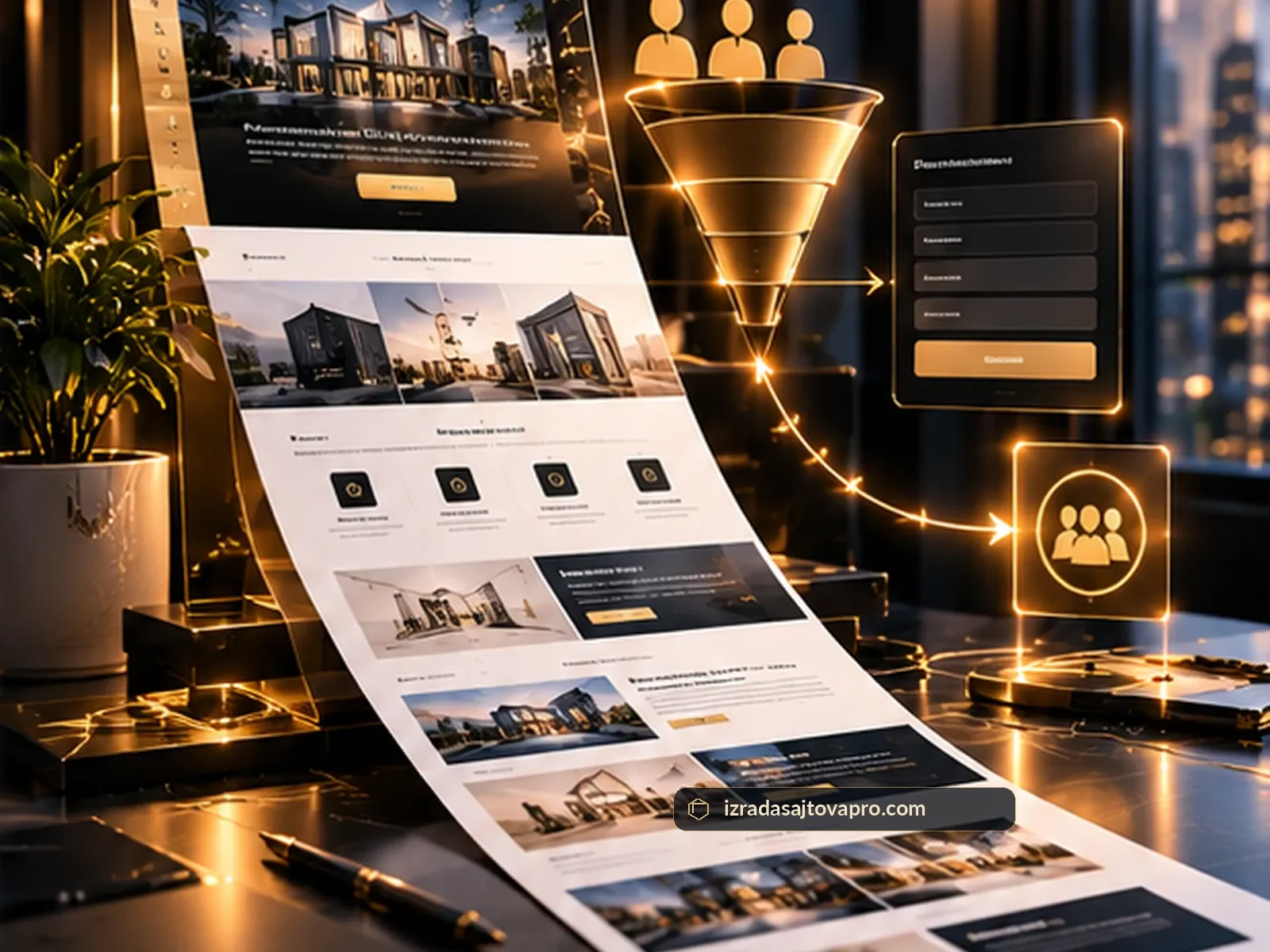
Goal and scope
For Landing page or website, we first clarify the business goal, the current situation and what the user should be able to understand or do. The scope follows that logic instead of a fixed template.
See how Landing page or website can support a concrete business goal, what the service includes, how the work is organized and which decisions matter before implementation.
For Landing page or website, we focus on the business goal, the scope that really matters, a clear content structure and reliable implementation. The points below show what is included and how the work is organized.
For Landing page or website, we first clarify the business goal, the current situation and what the user should be able to understand or do. The scope follows that logic instead of a fixed template.
We organise the content for Landing page or website so that the main offer is easy to scan, important questions are answered at the right moment and the next step is visible without unnecessary friction.
Implementation for Landing page or website is checked on real screen sizes and against the functions that matter for the page. Where relevant, we also verify tracking, forms, search signals and technical dependencies before launch.
Our approach to Landing page or website starts with the goal and available inputs, then moves through structure and content to implementation and verification. This keeps decisions connected to a practical outcome rather than isolated design or technical choices.
We define the goal, audience, existing assets and constraints that matter for Landing page or website.
For “Landing page or website”, we turn those inputs into a clear structure, useful content and a user journey that supports the intended action.
For “Landing page or website”, we implement the agreed scope, test the important paths and check the technical details before the page, campaign or configuration is considered ready.
Yes. For “Landing page or website”, we first review the current situation and keep what already works. The scope is adjusted to the real goal, existing assets and technical constraints.
For “Landing page or website”, we need a short description of the goal, access to relevant accounts or the existing website when needed, and the business information that should be reflected in the final result.
For “Landing page or website”, we agree the deliverables in advance and verify the relevant user journey, technical checks and measurement points before handover or launch.
Choosing between a high-converting standalone landing page and a full-featured multi-page website is one of the most consequential decisions in digital strategy. Understanding their fundamental differences ensures your capital investment yields the highest potential return.
Engineered with laser focus, a landing page removes navigation clutter to drive immediate conversions from targeted advertising campaigns. It answers one specific promise for one specific audience.
Designed as a comprehensive brand headquarters, a website provides trust, depth, SEO authority, and structured exploration across multiple products, services, company history, and educational content.
When evaluating digital infrastructure, business leaders often fall into the trap of viewing a landing page and a multi-page website as mutually exclusive choices. In reality, they are specialized tools designed for distinct phases of the buyer's journey and different marketing acquisition channels. A standard corporate website acts as a digital flagship store, welcoming curious visitors, building broad domain authority, and communicating market stability. In contrast, a specialized landing page functions as a precision surgical tool engineered to capture immediate demand generated by targeted pay-per-click (PPC) campaigns, social media ads, or direct promotional offers.
The fundamental divergence between these two web assets lies in their user experience philosophy. A complete website encourages exploration. It offers navigation menus, search bars, blog links, service catalogs, and corporate disclosures. This open structure is ideal for users in the awareness or early consideration phase who require multi-touchpoint validation before making a decision. However, when you pay for direct ad traffic via Google Ads or Meta Ads, this freedom of movement becomes a conversion bottleneck. Extra links provide exit routes, diluting the user's focus and depressing conversion rates. A landing page eliminates external paths, funneling every drop of visitor attention toward a single primary Call to Action (CTA).
To maximize digital efficiency, it is crucial to analyze how landing pages and corporate websites handle visitor intent, attention spans, and promotional momentum.
A standalone landing page is built around a singular message match. When a user clicks a hyper-specific ad promise (e.g., "Emergency Commercial Plumbing in Belgrade"), landing on a general homepage causes cognitive friction. A dedicated landing page instantly validates their intent, presenting a direct solution, social proof, and an unhindered booking mechanism within seconds.
A full-fledged business website serves as the bedrock of long-term digital enterprise value. It establishes multi-dimensional topical authority for search engines while providing buyers with comprehensive information regarding brand values, team credentials, client case studies, and compliance details.
Selecting the optimal path depends on your immediate marketing strategy, budget availability, sales cycle complexity, and primary customer acquisition channels.
To prevent misallocation of budget and time, we have established a clear decision matrix based on real-world campaign analytics and market dynamics across hundreds of client deployments.
Performance benchmarks differ significantly between single-page conversion environments and multi-page corporate portals. Here is how key parameters stack up under technical scrutiny.
| Feature / Parameter | Dedicated Landing Page | Full Business Website |
|---|---|---|
| Primary Objective | Direct conversion (Leads / Sales) | Brand trust, SEO ranking, information hub |
| Target Audience Intent | High commercial/transactional intent | Informational, navigational, and commercial intent |
| Traffic Sources | Google Ads, Social Ads, Email lists | Organic Search (Google), Direct, Referral, Social media |
| Conversion Rate (Average) | High (5% – 25% depending on offer) | Moderate (1% – 4% site-wide) |
| SEO Scalability | Limited (ranks primarily for 1-2 keywords) | Extremely high (unlimited page expansion) |
| Navigation Structure | No navigation links or anchor scroll only | Multi-level global menu, breadcrumbs, search |
| Development Timeline | Fast (3 – 7 working days) | Comprehensive (2 – 6 weeks) |
Why do dedicated landing pages achieve significantly higher direct conversion rates, while full websites excel at long-term customer education and retention?
Human cognitive bandwidth on the web is extremely scarce. According to eye-tracking and usability studies, modern web users decide within 3 to 5 seconds whether a web page satisfies their search intent. When visitors land on a page that presents multiple competing options—such as header menus, social widgets, footer links, and secondary promotional banners—they suffer from choice overload, clinically known as Hick's Law. Hick's Law states that the time it takes to make a decision increases logarithmically with the number and complexity of choices.
By drastically paring down interactive elements on a landing page, you streamline the decision pathway into a binary choice: either complete the desired action or leave the page. When paired with high-converting copywriting, persuasive visual cues, micro-interactions, and prominent trust triggers (e.g., client logos, verified reviews, SSL badges), the conversion rate routinely jumps 2x to 5x higher than sending paid traffic to a corporate homepage.
Conversely, a full corporate website addresses multi-stage buyer behavior. B2B enterprise buyers, high-ticket service clients, and cautious consumers rarely purchase on their initial session. They require structured navigation to review your case studies, examine pricing tier breakdowns, assess team credentials, and digest blog content. On a website, seamless UX design focuses on intuitive category hierarchies, contextual internal linking, fast site-wide search mechanisms, and persistent global headers that maintain orientation across deep pages.
How do search algorithms evaluate standalone landing pages versus broad authority domains, and how should you align your marketing channels accordingly?
A single landing page often struggles to compete for high-volume broad keywords in organic Google Search against comprehensive multi-page competitors. Google's Search Quality Rater Guidelines heavily emphasize Topic Authority and E-E-A-T (Experience, Expertise, Authoritativeness, Trustworthiness). A single page lacking supporting blog content, internal link context, and author profiles typically struggles to aggregate enough domain power to rank for competitive search terms organically.
However, when paired with Google Search Ads (PPC), a landing page shines. It maximizes Quality Score by providing direct message match between the search keyword, ad headline, and landing page content, thereby lowering your Cost-Per-Click (CPC) while boosting ad position.
A full-scale website is engineered for organic search scalability. Every newly published service page, location landing section, and in-depth educational guide creates an additional indexable entry point for Google's web crawlers. Through systematic On-Page optimization, semantic keyword targeting, technical XML sitemaps, structured schema markup, and strategic internal link distribution, a full website builds compounding domain authority.
Over time, this organic equity generates a predictable stream of zero-cost traffic, reducing your overall dependence on paid ad channels and lowering your aggregate Customer Acquisition Cost (CAC) over the long term.
Speed is not merely a technical luxury—it is a critical ranking factor and a direct influence on conversion rate economics.
We ensure hero visuals and critical text render in under 1.2 seconds, keeping bounce rates exceptionally low on mobile networks.
Zero visual jumps during asset loading prevent accidental clicks and maintain seamless reading experiences for touchscreens.
Ultra-responsive form buttons and interactive elements respond instantly, eliminating friction during user lead submission.
Whether developing a lean single-page conversion asset or an enterprise-grade web application, performance optimization remains non-negotiable. Google's official data reveals that as page load time increases from 1 second to 3 seconds, the probability of a mobile visitor bouncing increases by 32%. If the page takes 5 seconds to load, bounce probability skyrockets by 90%.
At IzradaSajtovaPro, our engineering stack avoids bloated visual builders and heavy unoptimized scripts. We build modern, highly optimized codebases utilizing clean semantic HTML, lightweight CSS architectures, modern web image formats (WebP/AVIF), server-side caching, and responsive asset delivery. This ensures flawless scorecards across Google Core Web Vitals for both standalone landing pages and extensive multi-page platforms.
Understanding the cost structures and financial yield of digital assets helps align digital investments with expected cash flow timelines.
A common mistake made by business owners is evaluating web development purely as a fixed expense rather than a capital investment with direct ROI metrics. The financial dynamics of a standalone landing page versus a corporate website differ significantly in initial cash outlay, ongoing maintenance burdens, and revenue conversion horizons.
Because a landing page centers on a single refined layout, initial custom design and coding require fewer total development hours compared to multi-page portals. However, landing page copy demands an exceptionally high level of persuasive psychological copywriting, strategic form placement, heat-map integration, and event tracking setup. The investment is concentrated heavily on conversion art and performance speed rather than architectural volume.
Developing a full corporate website involves broader scope: site mapping, content hierarchy creation, multi-page layout design, custom CMS setup (such as tailored WordPress or custom web frameworks), search engine optimization structure, multi-language toggles, and complex database integrations. While initial capital expenditure is higher, a well-optimized website creates a permanent corporate asset that builds compounding organic equity over years.
How to evaluate return on investment based on customer acquisition economics and traffic acquisition models.
Landing page ROI is measured directly through immediate conversion metrics and acquisition cost benchmarks:
Website ROI is evaluated through equity accumulation, organic search value, and long-term buyer lifetime value (LTV):
Our proven development process guarantees that whether you build a landing page or a multi-page site, every asset is delivered on schedule, fully tested, and optimized for sales growth.
We analyze your business model, target audience, competitive landscape, primary acquisition channels, and concrete conversion goals.
We craft high-impact headline messaging, psychological conversion hooks, clear benefit sections, and structural visual wireframes.
Our designers create modern pixel-perfect layouts reflecting your brand identity, establishing strong visual hierarchy and mobile responsiveness.
We convert approved designs into lightweight, secure code optimized for lightning-fast loading speeds and full Core Web Vitals compliance.
We integrate Google Tag Manager, GA4 event tracking, Meta Pixel, and call conversion tracking to monitor every form submit and phone call.
Rigorous cross-browser testing, mobile usability checks, form validation, security hardening, and DNS optimization before final go-live.
Examine how real businesses applied these web strategies to solve revenue challenges and dominate their respective markets.
Challenge: Running Google Ads to a generic multi-page homepage resulted in high bounce rates (78%) and an unsustainable Cost Per Lead of €140.
Solution: Designed a streamlined dedicated Landing Page focusing exclusively on executive audit offers with zero menu distractions and prominent client testimonials.
Result: Conversion rate surged from 1.8% to 11.4%, cutting Cost Per Lead down to €32 and generating €180,000 in new pipeline revenue within 60 days.
Challenge: Relying solely on social media advertising yielded inconsistent leads without establishing permanent search authority in their region.
Solution: Developed a multi-page SEO-optimized Website featuring individual service pages, doctor profile credentials, localized SEO schema, and an online booking engine.
Result: Ranked #1 organically for 34 high-value regional dental keywords within 7 months, attracting 120+ organic appointment requests monthly without active ad spend.
Challenge: Launching a flagship innovation product within an existing multi-category online store resulted in buried visibility and customer confusion.
Solution: Implemented a Hybrid Strategy—building a high-converting dedicated Landing Page for Meta ad traffic that seamlessly linked to the main store cart upon checkout.
Result: ROAS (Return on Ad Spend) jumped from 1.6x to 4.2x during launch month, while preserving overall store domain authority.
Key recommendations from our digital team before embarking on your next web development project.
To ensure your web project delivers maximum commercial efficiency, consider these strategic guidelines curated over 20+ years of studio experience:
In-depth technical and strategic answers to common questions asked by founders, marketing directors, and business owners.
Absolutely. When we build landing pages at IzradaSajtovaPro, we use clean, modular HTML5/CSS3 or structured CMS architecture. This allows us to smoothly integrate additional service pages, blogs, and complex features at a later stage without throwing away initial work.
If budget is constrained and your goal is quick cash flow validation through paid advertising, starting with a targeted Landing Page is typically more cost-effective. If your model relies on brand building, investor pitch validation, or multi-service showcase, a full Website provides greater long-term credibility.
A custom-built landing page with complete copywriting, visual design, mobile optimization, and conversion tracking typically takes between 3 to 7 working days. A full business website ranges from 2 to 6 weeks depending on page count, content readiness, and specialized custom integrations.
Generic visual templates often carry heavy code bloat, slow server response times, poor mobile responsiveness, and unoptimized layout structures that damage both Google Quality Scores and organic SEO rankings. Custom-engineered pages guarantee ultra-fast loading, total design freedom, higher ad quality scores, and lower customer acquisition costs.
Google Ads evaluates landing page relevance, page speed, mobile usability, and message match. Send ad traffic to an optimized dedicated landing page to boost Quality Scores (8/10 to 10/10), which directly reduces your Cost-Per-Click (CPC) and improves ad positions compared to pointing ads at a generic homepage.
Send the essential information and receive a clear proposal for scope and next steps.